Thursday, June 12, 2014

Folding bikes, or exquisite bikes that just happen to fold?

Folding Bike Discussion: Why?

Folding Bike Discussion: Featuring Brompton, Dahon & Tern folding bikes

Of late, I've been asked, "why folding bikes, what's up with all the folding bikes?" I like to start the answer with: "Is it a folding bike, or a bike that just happens to fold?" For me, that is the question, is it not? Truly speaking, it's an interesting question to ponder these days as we deem it fit to classify and sub-classify just about everything. There are many "folding bike" companies throughout the world, but I will limit my specific comments to the three brands, which I consider the best in the world--Brompton, DahonTern (in no particular order, but alphabetical.)

Although these companies started their bicycle-industy-lives a "folding bike companies," I can assure you that for at least one, though I presume for the other two as well, the company wants to be considered as a wonderful riding bicycle, that just so happens to fold. The case for the "folder" as they are often referred, begins with a discussion of physical space, or the lack thereof.

With so many people throughout the world living in crowed cities, or living in smaller dwellings in uncrowded area, many people want a compact form factor for storage--hence the folding bike. Once you try one, I am confident many people would see the utility in a bicycle that folds. Simple as that.

Many people travel by bike daily and need to be able to take it with them during their daily tasks to avoid the issue of parking, locking and theft of their bicycle--hence the folding bike. Corollary to this, many people travelling frequently by train, plane, or boat also have a use for a compact and portable means of transportation at any given destination or port, at virtually any time--again, hence the folding bike.

Many people, for many different reason, prefer a smaller bicycle with a lower standover height which are easier to mount and dismount--hence the folding bike. I was recently in London at a dealer conference for Brompton Bicycles, and we all stood in amazement at the picture of a 4'11" woman standing next to her Brompton while standing next to a 6'7" gentleman with his Brompton--classic tall and short picture with one twist--the SAME bike (granted different handlebar.) Whether an ailing hip or other physical complication, some people simply like the smaller form and smaller wheel; the folding bike offers many options for many people to continue riding bicycles. Amazing.

Are there people that ride folding bikes that rarely if ever fold them? Probbably, and that's ok, because a bike is a bike is a bike, and as long as you're happy riding one, then does it really matter particularly if it's got 16", 20", 24" or larger sized wheels? I think not.

We often joke that the perfect number of bikes for one's household is N+1, but some people just don't have the appetite, resources or space--sorry to be redundant, but "hence the folding bike." Whether for utility, pleasure, or performance, pedal only or electric assist (or any combination thereof) there is probably a folding bike out there.

Hopefully that helps understand why someone would find a bike that folds so useful. I would also encourage any one that thinks that folding bikes equals a "clown bike" to ride one just to dispel this myth. The folding bikes we carry have full length wheelbases when compared to larger sized wheel bikes--this gives them the stability and ride quality of a larger wheeled bicycle. The slightly quicker handling of the smaller wheels is quickly overcome after a few rides; there's a bit of an optical illusion or expectation of not seeing "more" wheel in front of the handlebars while riding along--again, just another nuance that will quickly disappear.

Lastly, we can wrap up this brief folding bike primer with a bit about each of the brands we carry.

Brompton M6L Hot Pink/Apple Gren

Brompton: Brompton's are generally considered the premium product in this category, though truth be told there are some Dahon and Tern models that are more expensive that the most expensive Brompton can be. The Brompton is the smallest folding bike  in the category because of its ingenious "trifold" design (and 16" wheel) wherein the rear wheel folds under the main frame. Bromptons are made from steel and titanium, one at a time in its factory in West London, UK. Buying a personalized custom Brompton (B-Spoke is their term) is possible because of their manufacturing process. An exquisite product indeed.


Dahon Vitesse D7HG

Dahon: Dahon is a Taiwanese company that has been in the folding bicycle business for over thirty years. The company founder, David Hon, always wanted to make a product that would improve, increase and enhance one's personal mobility, and his bikes have stood the test of time. The price points are generally less expensive than Brompton, though not always and are made in China. We've recently carried some of the Dahon bicycles starting at just $300, which is incredible for someone to start their folding bike experience. Most of the models in the Dahon line have 20" wheels, though there are a few with 16" and 24" wheels as well.

Tern Link P7i


Tern: Tern, a Taiwanese company, is the newest entrant into the folding bike category as of 2011. Tern has designed 20", 24" and 26" wheel folding bikes--though we will only be stocking the 20" and 24" for the time being. The Terns have some beautiful designs seen their lines and aesthetics, and like Brompton, have an integrated luggage system for their bicycles. Tern will also be the presenting an electric bike version of their most popular styles. Opening price points for a Tern is a bit more than Dahon, and as mentioned, some being even more expensive that an fully equippped custom Brompton. Useful options are rear and front luggage points, fenders, dynamo lighting and adjustable stems, which is not often the case in the category. Like Dahons, when it comes to folding, Terns basically fold in half, hence the bi-fold term.

Friday, February 7, 2014

Rebuilding a very special bike >>>


The Peter Mooney that was brought in last week had been out of service for several years and needed some updating. The original wheels and tires were well worn out and needed replacement. We matched the silver Campagnolo Record 9 speed components that were still in great condition with White Industries T11 hubs in polished silver with Silver DT Spokes and color matched the aluminum nipples to the vibrant blue frame. He wanted a to use 25c tires for a fast comfortable ride and the Peter Mooney frame had clearance to spare even when mounted on the HED Belgium rims. The tires measured 28.2 mm. when mounted. The wheel set is laced 2 cross rear (28h) and radially in the front (24h) for a lightweight, durable wheel set that will accelerate with some snap. total weight - 1,560 g

We rebuilt the rest of the bike with some fresh cables, bar tape and brake pads and overhauled the rest for a bike that looks as good as it rides. Now returned to it's former glory, the Peter Mooney is ready for many years of service. I'll let the photos do the rest of the talking for me.
For more info on wheels and why custom may be right for you, please contact me by email : gene_ruiter@cycleloft.com


Sunday, January 5, 2014

SONdelux Dynamo Front Hub 650B Wheels for Randonneuring

 
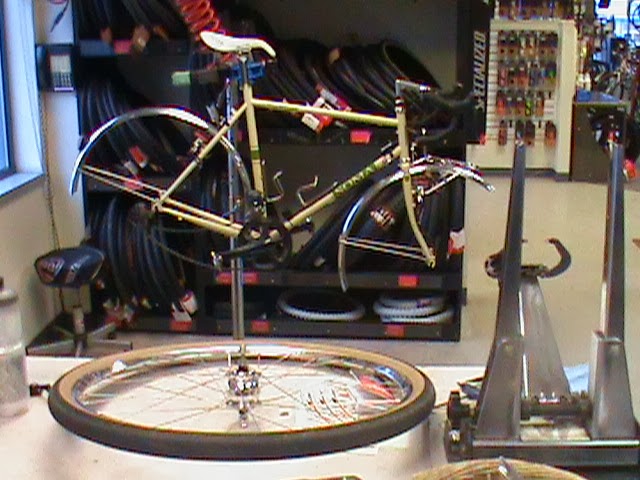
Greatly in need of wheels to be complete, the Soma Grand Randonneur also needed lights to be a true randonneuring bike. A specialty Dynamo hub fit the docket to do double duty. The 390 g. SONdelux dynamo hub (Schmidt's Original Nabendynamo) is a low drag front hub that produces 3 watts of electric current to power 6 volt front and rear lights, and as an additional feature a module with a USB port to power auxiliary devices such as a smart phone or GPS is available as an aftermarket accessory. Nifty. See in the dark and not get lost? No brainer for your upcoming 1200 Km. event or for daily commuting. 32 hole Velocity A23 rims allow for heavy duty usage using wider tires like the ones shown to provide a smoother ride for the long road.


Left: Wilfried Schmidt Maschinenbau front light. Available in upright and inverted mounting options, this light provides the best output and uses an assymetric beam to direct light on the road and reduce glare for oncoming traffic. Stays illuminated while standing, say, at a traffic light for instance... stay sharp!


Left:  SECULA plus ist das ideale Rücklicht für die Schutzblechmontage
         "Seculums plus is the ideal taillight for rear mount"
"Linitec" technology for a broad beam with a large reflector built in. Uses .6 watts of power for a low drain on the headlight. Cleanly mounts into fenders, but is available in seatstay mount and various other positions.


280 g Suzue Classic sealed hub oozes class, not grease, thanks to sealed Japanese bearings, high flanges, and a polished finish to create a beautiful durable wheel.
 

                                                               Artsy Faux Floating Wheels Angle

 
 Front Hub side profile

 
Rear Hub side profile
 
Thanks for reading. It's always fun to work on some of these unique projects. Technology, specifically German, has made available many intriguing designs for specialty usage that retain a seamless utilitarianism. It's easy to see that a bike with lights that don't need recharging make a lot of sense for someone who's on a bike all the time or even for those sensational recreational riders, but it is rare to find one. The same is true of bikes with fenders. Although these common sense features are coming into vogue in bicycle design as the general public continues to expand it's propensity for such a mode of transportation. With increasingly crowded roadways and the limited resources to sustain the gridlock of the daily grind, there is an alternative. That alternative doesn't have to be poorly lit. Relacing the SON delux hub and adding a light to your current bike is not all that difficult or expensive and could be one of the best time investments. That is, no longer taking the time to recharge your lights or riding in the dark haphazardly because you forgot to. Something to consider down the road. For more info or to plan something special contact me: gene_ruiter@cycleloft.com
 

Sunday, December 15, 2013

Wider is better...your rims, not your butt...


Wider is Better: HED Belgium C2 Clincher Rim
23 mm wide rim (L) vs. 19 mm rim (R)
 

 The HED Belgium C2 clincher is a 23 mm wide scandium aluminum alloy rim in sea of aluminum road rims. This new road rim width standard is being adopted currently by almost all major brands due to its ability to deliver better cornering characteristics and ride quality out of tires. The larger volume created by the increased rim diameter allows for lower pressure in the tire. Additionally, a 25 mm Continental Grand Prix tire measures 28.2 mm on the Belgium rim when inflated to 95 psi. creating greater comfort without sacrificing rolling resistance. HED is one of the innovators of this rim size for road bikes and they outline their case for the Ardennes C2 SL wheels on their website stating;

“But what makes 23mm better than the ubiquitous 19mm rim width? Picture a standard 23mm tire on the C2 rim. Tire and rim width are the same, the sidewalls are fairly straight, and the width of the rim spreads the tread contact patch out. With straighter sidewalls, and more rubber on the road, cornering is an entirely new experience. The sidewalls don’t flop over in a hard corner, and more rubber on the road is, well… better. C2s should be run with lower pressure, since there is more air volume in the wider tire profile. The same tire on a 19mm rim looks more like the profile of a light bulb. The curved sidewalls flop over under hard cornering, there is less rubber on the road, and more air pressure is needed to prevent pinch flats.”
Velo News had this to say about the HED Ardennes wheel set which utilizes the same C2 rim available to custom wheel builders: "Simply put, these are the best-feeling clinchers we have ever ridden and we see no reason why their sublime qualities should be limited solely to competition use. Use them for training, use them for climbing, use them for race day… but just use them. They’re that good."

It may sound like hype but it’s true, and it’s the main reason so many other companies are following suit.  I have been using the HED Belgium C2 rim on the majority of my custom wheels for the last two years. This 23 mm wide scandium rim is the best of the wide rims out there for road riding and racing on the market. Ask around, and you’ll see many riders and wheel builders agree. The machining is perfect. The weld is smooth. Every rim is perfectly round and tensions up seamlessly to yield an evenly tensioned, stiff wheel that rarely, if ever, goes out of true. Not to mention they are much lighter than a standard aluminum rim in the same width. 

Riders during the Deerfield Dirt Road Rondonee (D2R2) in Shelburne Falls, Ma - The perfect environment for a great set of wide rims with 28 c road tires to make you want to bicycle samba all day.

 I’ve received a lot of feedback on these from my customers who abuse them regularly on the plethora of dirt roads that Massachusetts, New Hampshire and Vermont and every single person is blown away at how responsive their bike becomes and that the wheels never need truing after 6 hour dirt road sessions back to back where their other wheel sets have failed miserably. I tell them it’s because of the reduced rotational weight and that 23 mm width really stiffens the wheel. Because scandium is so light yet incredibly strong I can use fewer spokes at higher tension giving the wheel a really lively feel without sacrificing durability or strength. I regularly build up 1450 gram wheel sets with this rim and my 200 lb’s is brutally honest when it comes to wheel performance. Comparatively ,a ZIPP 303 clincher wheel set weighs 25 grams more and may land you in divorce court when she finds out how much you spent on wheels…for a bicycle.

Other features that make this rim nice are the technical attention to detail like the offset spoke holes on the inside of the rim that makes building them easy. No having to fight to keep the spoke straight when installing nipples. The matte finish has a kind of subdued lusty appeal when contrasted with the high polish machined brake track. The rims cost about $150.00 each, so what, there worth it! Virtually every company who makes wheels has a 23 mm. rim in the lineup, but few that have welded and machined seams or the performance and feel of scandium, besides, HED were the first to run with the 23 mm width for road rims and they continue to innovate and expand with the Belgium + rim at 25 mm. wide, tubeless, and an option of disc specific sidewalls. There are some cheaper alternatives but after riding the Belgium C2 rim they won’t even be an option.
One of our local collegiate CAT 3 racers had these HED Belgiums laced to a Powertap G3 rear hub and DT 350 front hub. He is 6'1" and weighs 175 lbs. These will be used to train and race on and with the reduced weight of the G3 hub these wheels come in competitively light at 1,790 g

 
These photos were taken before the snow started flying here but the wind that day was upwards of 40 mph. Now that winter is in full swing it's a good time to start planning for a wheel set that will bring you some results in the spring. Contact me : gene_ruiter@cycleloft.com 781-272-0870
for more info or to Demo a set of wheels that could change the way you ride.
 

Tuesday, December 10, 2013

Parts of a wheel - The good bits.


January 4, 2012
Hello there, speedfreaks!  Today we are going to more or less go in depth about wheels... talking about what makes a wheel fast.  There are four components to look at: hubs, spokes, nipples and rims.  I'll cover Hubs and rims here and spokes and nips next time. 
Depending on the terrain, a wheel is fast under any given circumstances in which it performs the best.  A wheel that responds coming out of a corner is fast.  A wheel that is lightweight will take less effort to spin up to speed and feel like it defies gravity going uphill is fast.  A disc wheel on the back of your bike can transform your bike into a freight train that there’s no slowing down once you get over 28 mph.  A deep carbon wheel set will react to every pedal stroke, etc… There are all around wheel sets that can cover any kind of situation well - without getting too far into highly specialized wheels that sit in a corner more than they're on a bike.
But at the center of every wheel is a hub.  A hub that rolls fast is the best hub, and high quality bearings and extremely tight manufacturing tolerances will ensure that your hub will roll fast for a long time. There are many options to select a hub that has high quality construction and bearings. 

Sealed bearing hubs from DT Swiss like the 240s - 314 grams/ pr, or  180 @ 290 grams a pair which use ceramic bearings and a lightweight freehub body have a unique star ratchet system which reduces drag over conventional pawl engagement designs. They set the standard for low weight high performance hubs with an incredibly simple design that is highly effective. Perfektion : Leave it to the Swiss...or the USA -  White industries T11 road hubs - 344 grams/ pr, and their new CX-11 11 speed cyclocross specific disc hub - 504 grams/ pr. 
are renowned for their quality craftsmanship and show finish– these hubs use high quality bearings, tight machine tolerances and a titanium freehub body that has the strength of steel with the light weight of aluminum.The spacing on the flanges is nice and wide at the front.   A large flange on the drive side has helped keep the tensions more even at the back and help prevent wind up.  The smaller flange on the non-drive side saves weight. Super sweet laser engraving- made in 'Merica! Titanium is a good choice for all riders because it is light as aluminum and strong as steel. So it keeps the weight down while preventing this .... 
Chris King hubs are amazing as well and have the renowned durability and quality that their name has come to be recognized with, providing a unique engagement system that transfers your power quicker than you can say breakaway. The R45 - 325 grams/ pr. is a revision of the classic King hubs. They have decreased the pawl engagement from 72 points to 45 to lower drag and reduce weight. What you can see in the cut away photo is King's patented Ring Drive system that offers faster engagement than a hub with pawls and is actually quieter. Chris King is the only manufacturer here that makes their own bearings and balls within the races. They make and use angular contact bearing which have a very high static load capacity - similar to a high quality loose ball bearing hub like Dura Ace. Super light aluminum axles and freehub body keep the weight anorexic. - Made in the U.S.A
  Of course, there is the old Japanese standby: Shimano.  These guys set the standard in design with their Dura Ace hubs, using a Titanium freehub body loose ball bearings, their bearing surfaces are precision machined to give the smoothest and most durable rotation assembly available.This is particularly important while a wheel is rotating on its axis where low grade sealed bearing can shift, increasing drag and slowing you down.
This is the big four favorites for wheel builders, but their are a myriad of excellent manufacturers out there that may fit your needs, budget, and aesthetic. Here are a few...Royce Ultralight/ Venus 432 grams/ pr., Alchemy Elf - 258 grams/ pr., KT - 328 grams/ pr , Hope Pro 2 Evo Disc hubs - 470 grams/ pr.. 

Choosing the right rim is precedent because you want something that is the best for the type of road feel and slippery wind cheating shape. On flat terrain where aerodynamics comes into play such as in a break away or time trial, a deeper section rim with a reduced spoke count or bladed spokes is best. A deeper section rim effectively reduces the spoke length needed to build a wheel, creating a stiffer stronger wheel. A stiff wheel is needed when a rider applies a great deal of lateral force to the bike when sprinting and climbing. Stiffness of a wheel reduces the lateral flex, thereby increasing the power transfer from the pedals to perpetuate forward motion. So rather than flexing side to side, a stiff wheel will allow a rider to get the maximum amount of power to the ground to go faster.
Let the terrain dictate the kind of wheel that will be the fastest for you. If comfort helps you go faster over rough roads, shallower rims are best. If pure speed is what you after than a deeper section rim with less spokes will improve the aerodynamics of your bike. Aero spokes will make it even faster. If you are a bigger rider, this may not apply and using more, thicker gauge spokes in a wheel will make you faster because there will be less chance that you will break a spoke and not be able to finish a ride or race. Rims we like to use have the best balance of modern technology and offer deep profiles for enhance aerodynamics and wider tire beds for stiffness and improved tire performance. What I'm talking about is wider is better, fo sho. Check out Bontrager's take on the world of tubeless compatibility with their Race Lite series.
Hed's Belgium C2 Scandium rims - 23 mm wide, and their new Belgium + , 25mm wide, are very strong and light even for the burliest of the burlesque. Welded seam and machined brake track. Disc specific rims have no machined sidewalls and look blacked out. If you've never ridden these, we have a set of Demo wheels for you to test.  For a complete custom wheel set starting at $700, these come in for less chowder than Hed's stock Ardennes wheelset and are guaranteed to blow your hair back.


H-Plus Son - Not urban slang for using a capital H - but a stout semi aero answer to Hed's 23 mm rim. With a welded seam and anodized or burnished aluminum finish options this rims make a statement and match pace with their performance.

Monday, December 9, 2013

Rim Profiles and the Effect on Aerodynamics


Rim Profiles and the Effect on Aerodynamics


Aerodynamics is key in addressing the way a wheel should be built.  I personally love a deep section rim with fewer spokes because it changes the entire ride characteristic of your bike and requires less effort to maintain speed.  I use a 66 mm. deep carbon wheel for all around riding and they really shine on race day.  I use 36h  aluminum rims for training where the increased weight and wind resistance aids in training.  Switching over to the deeper rims for racing just makes the bike feel so much faster as they provide the best aerodynamics to stiffness ratio.  The only downfall of an aerodynamic rim is that more material is needed to make a deeper section rim and they tend to be heavier. Deep section rims range from around 30 mm. to 90 mm. deep. Carbon fiber rims provide the best benefit of a deeper aero profile without the weight penalty of an aluminum rim.  Carbon rims can be built much deeper than aluminum rims but with much less weight than a similar profile aluminum rim.  Case in point: a Mavic Open Pro rim with an 18 mm depth weighs about 430 grams.  A 46 mm deep carbon rim weighs 450 grams.  Because carbon is very strong it can be built with less spokes, thereby reducing overall wheel weight compared to the Open Pro built with 32 spokes, and it will still be stiffer.  Carbon rims are commonly found in incremental depths averaging 35 mm., 45 mm., 65 mm., and 80 mm.  In this regard they are ideal, but quite expensive.  A good compromise is to use a 27- 38 mm. deep aluminum rim to keep the cost and weight down when looking for an affordable aerowheel.  The deeper the rim the more aerodynamic and stiff it will be.

This is not to say that lower profile rims cannot be built to be stiff.  A traditional box section rim can be built using more spokes to get be quite stiff.  In effect, this will increase the weight and lower the drag co-efficient, making them a less aerodynamic option.  Most aero aluminum and carbon rims are built with fewer spokes, typically between 16-24 on the front wheel and 20-28 spokes on the rear.  Using fewer spokes reduces the overall weight of the wheel and provides better aerodynamics by decreasing turbulent airflow or increasing the drag co-efficient. Select aero bladed spokes with a flat cross section to slice through the atmosphere and you will really reduce drag. Traditional aluminum box section rims vary in depth from 18-27 mm. Rim depth greatly affects the ride quality of a wheel.  Lower profile or shallow depth rims provide a lively ride quality that has better rebound and can dampen the ride.  This, in part, is due to the fact that there is less material to provide rigidity as well as the use of longer spokes required to build the wheel, which provide more “spring”.

If you've ever witnessed the spring classics such as Fleche Wallone, Flanders or Paris-Roubaix you’ll see a large number of riders on traditional box section aluminum rims built with 32 or 36 spokes per wheel. Modern bikes and riders with seemingly dated wheels... This is because the tenacious nature of these races drives riders over the roughest roads and teams use them because they provide the greatest amount of strength and comfort in the most adverse conditions.   Increased spoke count on a wheel improves durability and makes them easier to repair by more evenly distributing the tension of the wheel to all of the spokes.

Reduced spoke count wheels (ie. 24h, 20h) have greater tension which puts a significantly higher amount of strain on the rim, pulling it in opposite directions.  The high tension makes for one responsive wheel that can transform a bike from feeling soggy to crisp.  But because of this higher tension, when a spoke breaks on an aluminum wheel, the rim will often permanently distort making it irreparable even when a spoke is replaced and the wheel is brought back up to the correct tension. Catastrophic failures of this nature make exotic aluminum wheels a gamble when riding over cobblestones.  Carbon Fiber rims are commonly built with higher tensioned spokes but don't suffer from radical distortion if a spoke breaks. Carbon has excellent elasticity and will continue to bend and return to its original shape. This means that replacing a broken spoke will bring it back to the original shape without distortion. The reinforcement of shape memory polymers makes carbon a malleable material to create distinct aero shapes with. When it cools it yields a contrasting material that yields under incredible force yet can be engineered to provide great stability and stiffness (or flexibility) in specific directions. This is important when creating a wheel that rides smoothly but has high lateral rigidity.  Every material has its limitations in terms of memory but carbon fiber has very high strength to weight ratio and requires incredible force to break when strained against it's layup. It has good impact resistance to a degree. A force that would dent an aluminum rim would crack a carbon rim, relegating it to the scrap heap while an aluminum rim would still be safe, but lumpy.. There is a breaking point, but it is quite high and difficult to convey the exact amount of force required for failure. A carbon tube used for a bicycle's top tube, say on a Tr#k requires approximately 3,600 lb's of force to break. When it comes to wheels there are a number of factors initiating dynamic force on it's makeup from the rider, road, and the inertia of two said masses converging at high rate of speed.
These properties in addition to its compliant ride quality and dampening characteristics make it an ideal material for rims used when riding on rough surfaces and many professional riders use carbon wheels in the spring classics. If you have any question about carbon rims being strong enough watch this... Of course, cost is a major factor when considering using carbon rims and teams have a quiver of wheels provided by sponsors. The traditional box section rims are still used by traditionalists who rely their tried and true durability.
.
(L)Tubular carbon rim at Paris Roubaix. (R) Ambrosio box section tubular at the same race.
 
In addition, the box section rims used by professional racers are tubular rims. Tubular rims are built without the taller bead of a clincher rim and require that the tire is glued to the rim.  I will cover tubular vs. clincher tires in another article.  The tubular rim can be constructed using less material, or lighter weight materials using a higher thread count (Think of how nice higher thread count sheets feel...) and is inherently lighter than their clincher counterparts. Tubular rims are used for this purpose and provide the benefit of running larger volume tires at lower pressure, contributing to a smoother ride quality from the added cushion, making them faster on rough roads or for cyclocross. A traditional 32 spoke tubular rim excels in this type of terrain where aerodynamics is not as influential. See Sheldon Brown's article on aero wheels that disseminates the stark differences between 36h traditionally laced wheels and 18 spoke 58mm deep carbon aero wheels - yet, somehow magically aligns them in sharing similar lateral and radial stiffness as only Sheldon Brown can do.

When considering the type of material to use when building a rim it is important to take into consideration the type of conditions that they will be subject to.  After all a wheel set is an investment that you want to get the most out of without having to save them for special events or ideal riding conditions.  Professional riders use carbon rims for all types of racing and training but they require more maintenance than an aluminum rim because the braking surface is more prone to wear when introducing dirt, sand and rain between the pad and rim.  Big teams have big budgets and wheel sponsors provide them with multiple sets of wheels to use day in and day out.  For the everyday cyclist who is considering investing in a set of carbon hoops regular maintenance will prevent wear and improve braking but be advised, if you ride all winter and never clean them after riding in the rain and slush the braking surface will wear significantly faster than an aluminum rim.  Many people use them for everyday riding because the performance of the wheels is addictive and they are, in fact, quite durable. The investment made for a good custom wheel set that is designed for the rider will pay dividends down the road and will be a pleasure to ride day in and day out. Increased aerodynamics benefits the road rider of any size defeat their greatest enemy and get to the point - which is to go faster.

 
---"Shut up legs wind!"
-Jens Voigt


-gene
gene_ruiter@cycleloft.com

Sunday, November 24, 2013

New Wheels - Functional, Stylistic, Aeroodynamic

Reynolds 81mm laced to White T11 - (20) DT Aerolite Spokes - 1010 g
A very deep profile for the rear wheel increases the drag coefficient of a bicycle to help it slip through the wind faster. Carbon fiber is the best material for this type of application because it is so much lighter than aluminum and allows for more extreme shape design to give it improved aerodynamic properties. This rim shape is possible with aluminum but would come with a huge weight penalty - which is why you never see it.


Super deep rim has the advantages of a disc wheel for time trial and triathlon, but is lighter and more maneuverable and versatile across other road riding disciplines thanks to Reynolds' patented SLG technology and offers better braking than it's competitor's with their CTG brake track.
White Industries is a small machine shop in Petaluma, CA that has been manufacturing highest quality USA made hubs, cogs, cranks, and pedals since 1978. The craftsmanship is impeccable and extremely durable and lightweight. Titanium freehub body is 11 speed compatible on their T11 hub for a seamless transition to Shimano and SRAM's latest componentry, while still compatible with 9 and 10 speed drivetrains. I've been using this hub on the majority of my wheel builds since it was released last year. This is a hub that you hold on to and use from bike to bike for years. $275 for the rear hub is cheaper than King and DT and weighs just 252 g.        

For questions and dream wheel consultations, please contact me here...gene_ruiterATcycleloftdotcom- thanks

Next up.... wider is better......and how?...HED Belgium Powertap G3 rear wheel / HED Belgium DT 350 front wheel

-Gene